
Easter Bread
This post may contain affiliate links. Please read our disclosure policy.
This Easter bread is a lightly sweet braided loaf with a soft crumb, golden crust and optional sprinkles. It looks lovely on the table and tastes just as good as it looks.
We make it for Easter, but it is also lovely for spring brunch or a holiday breakfast. It’s delicious on its own, lightly glazed or with butter and jam.
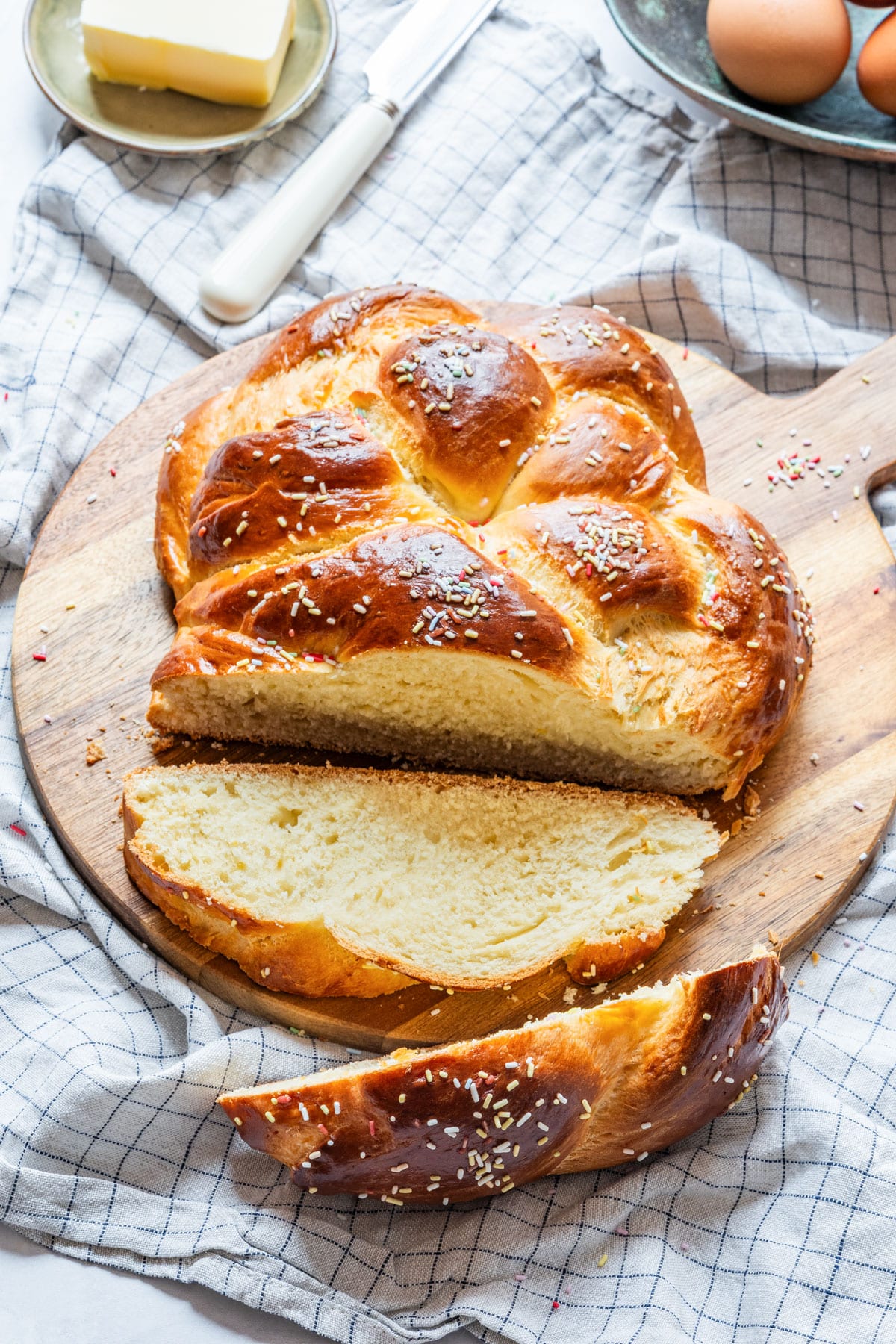
How to make Easter bread from scratch
Gather the ingredients:
- Flour: You will need all-purpose flour (US)/plain flour (UK). Don’t substitute with self-rising flour!
- Sugar: White, granulated, but preferably with fine sugar crystals. It is also called superfine/caster sugar (UK).
- Salt: Important for balancing the flavor.
- Milk: I use whatever I have on hand, either full-fat or low-fat milk.
- Egg: A large egg works best here.
- Unsalted butter: Do not use butter substitutes. This Easter bread recipe calls for the real deal.
- Lemon zest: It adds only a little flavor, so you can omit it if you don’t have a lemon on hand.
- Yeast: Another must for this Easter recipe to work. If you are looking for a sweet bread without yeast, try one of the quick breads, like lemon lavender loaf.
- Colorful sprinkles: These are completely optional.

Prepare kitchen utensils:
- Stand mixer with hook attachment.
- Spatula: I use it to mix the ingredients and help the dough come off the sides of the bowl, if needed.
- Measuring cups and spoons: Or a scale. In baking, a scale gives the most consistent results. If using cups, spoon the flour in lightly.
- Baking sheet or tray lined with baking parchment paper: If you have a silicone mat, use it instead.
- Saucepan: To heat the milk on the stove or a mug if you are using the microwave.
- Pastry brush and a little bowl: For the egg wash.


The process can be divided into five main steps:
- Mixing, the shortest step, but an important one.
- Proofing, the longest step, especially in a cold kitchen.
- Shaping, where you braid the dough and form it into a loaf or wreath.
- Proofing again, so the bread has time to rise properly.
- Baking, until golden and cooked through.


Possible substitutions
- Sprinkles: Slivered almonds, white sesame seeds, poppy seeds, pearl sugar.
- Instant yeast: Active dry yeast (the same quantity but needs to be activated in lukewarm milk) or fresh yeast (three times more in weight measurement and also needs to be activated).
- Milk: A half and half/single cream can also be used or a combination of milk and cream. Water is also an option, but it will not be as rich.

Frequently asked questions
This is a lightly sweet yeast bread shaped into a braid or wreath. There are many versions of Easter bread, and this one is a simple homemade loaf finished with optional sprinkles.
Absolutely! You can simply skip the part where both ends of the braided bread are pinched together and leave it as it is. It will look like Challah, another tasty bread. Or, roll the dough into 6 ropes/strands and make 3 smaller breads with 2 strands each.
Yes, you can. Bake, cool it down completely and slice. Place the slices onto a small baking sheet lined with parchment paper. Flash-freeze for 30 to 60 minutes. Then, transfer into a resealable freezer bag. This way, the thawing is faster!
This is to prevent the sprinkles from melting/turning brown during the baking process, as not all the nonpareils are bake-resistant.
If you know your brand does not melt or discolor when in the oven, you can use the egg wash and sprinkles before baking the bread.
There are two main reasons behind this: First, the room is too cold, so proofing takes longer. Second, the ingredients used were cold, which slowed down the rising process.
My favorite trick is to place it in a small bowl, pour hot water over it and let it sit for 10-15 minutes. The water will heat up the egg and you can use it in baking shortly after.

Julia’s tips
- As with most yeast breads, it takes a while to proof the dough, as many recipes require two proofings. It takes a while, but most of that time is hands-off. While it can take hours from beginning to the final “product”, there is a lot of passive time where you don’t need to do anything, just wait.
- Sometimes, the dough can be rather dry. This can happen. Some flours contain more moisture than others. To avoid it, don’t overfill your measuring cups with flour and add more liquid if the dough is not coming together.
- Egg wash is also optional. If you skip the sprinkles, you can skip the egg wash as well.
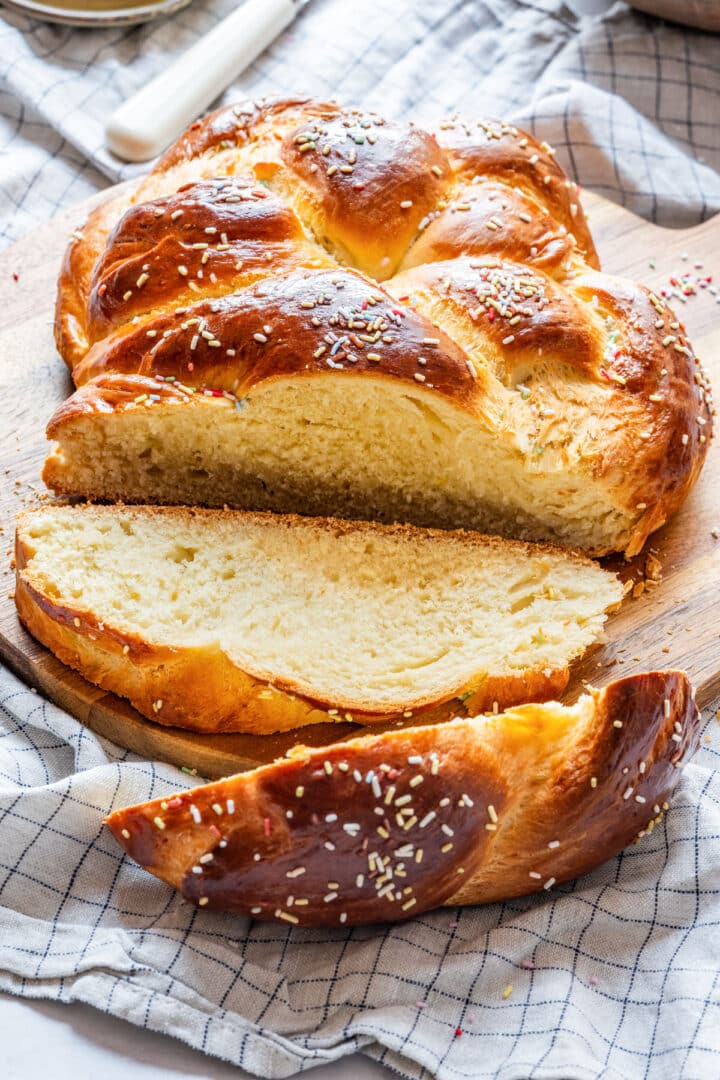
How to serve Easter bread
We usually serve it plain or with butter and jam. If you like homemade toppings, try this homemade butter or strawberry jam. It also goes well with coffee or tea.
If you have leftovers, toast a slice the next day and top it with a little butter, jam or honey.
While we bake it for Easter, it is also nice for a spring brunch or a slow weekend breakfast.
More Easter recipes you might like
For baking, try hot cross buns. If you are planning a full meal, add slow-roasted leg of lamb, and for dessert, chocolate Easter cake or Easter bunny cupcakes are lovely options.
Easter Bread Recipe
Ingredients
- 2½ cups all-purpose flour spooned and leveled, see note 1
- ¼ cup granulated sugar
- 1¼ teaspoons instant yeast see note 2
- ½ teaspoon salt
- ½ cup milk lukewarm
- 1 large egg room temperature
- 1 teaspoon lemon zest from 1 lemon (optional)
- ½ stick unsalted butter cubed
- 1 teaspoon sprinkles (optional)
Instructions
- To a bowl of a stand mixer, add flour, sugar, yeast and salt. Stir with a spatula until well combined.
- In a small bowl, whisk together milk and egg. Save about two teaspoons for later. Add the rest to the stand mixer bowl and stir with the spatula.
- With the dough attachment, mix on low-medium. When the dough starts coming together (looks like one piece with some dry flour pieces at the bottom), add lemon zest and 1 or 2 butter cubes. Note: If too crumbly and dry at this stage, add a splash of water or milk.
- Mix in the mixer for 15 minutes, adding 1-2 butter cubes at a time, every 2 minutes or so. I recommend turning off the mixer halfway through and pushing down the dough, or scraping it from the sides of the bowl – this helps for an even mixing. Then continue mixing and adding butter.
- When done, cover with clean kitchen towel and let it rise. It can take 60 to 90 minutes, even 2 hours, depending on how warm your room is.
- When the dough doubled in size, punch it down. Transfer it onto a clean worktop and knead a few times. Divide into 3 equal-sized pieces.
- Roll each piece into a 16-inch (40-centimeter) rope. Place them side by side and pinch one end together. Then braid by bringing the outer ropes over the middle one, alternating sides. You can leave it as a loaf or bring the ends together to form a wreath and pinch them together.
- Transfer the shaped dough to a lined baking sheet, cover loosely, and let it rise again until puffy.
- Bake in a preheated oven at 350°F (180°C) for 25 minutes. Then, take out and use the saved egg wash to brush it over the bread and quickly add sprinkles. Put the bread back in the oven and bake for a further 5 to 10 minutes before taking it out.
- Enjoy!
Notes
- The weight measurements are the best choice in baking to achieve the most consistent results. If using cups, don’t overfill the cups! Every flour contains a different moisture level, so you might need to adjust the liquid accordingly. I suggest having an extra ¼ cup of milk on hand if the dough is too dry.
- Instant yeast can be substituted with active dry yeast in the same quantity. But you need to activate it in lukewarm milk.
- Instead of sprinkles, you can use slivered almonds, poppy seeds or sesame seeds.
Nutrition
Nutrition information is an estimate provided by an online nutrition calculator and may vary based on ingredient brands, substitutions, and portion sizes.
Just made this challah and it turned out amazing. So soft and just sweet enough. The braiding worked out great too thanks to your easy instructions.
Hi Angela. Thanks so much for your comment. Happy Baking!